
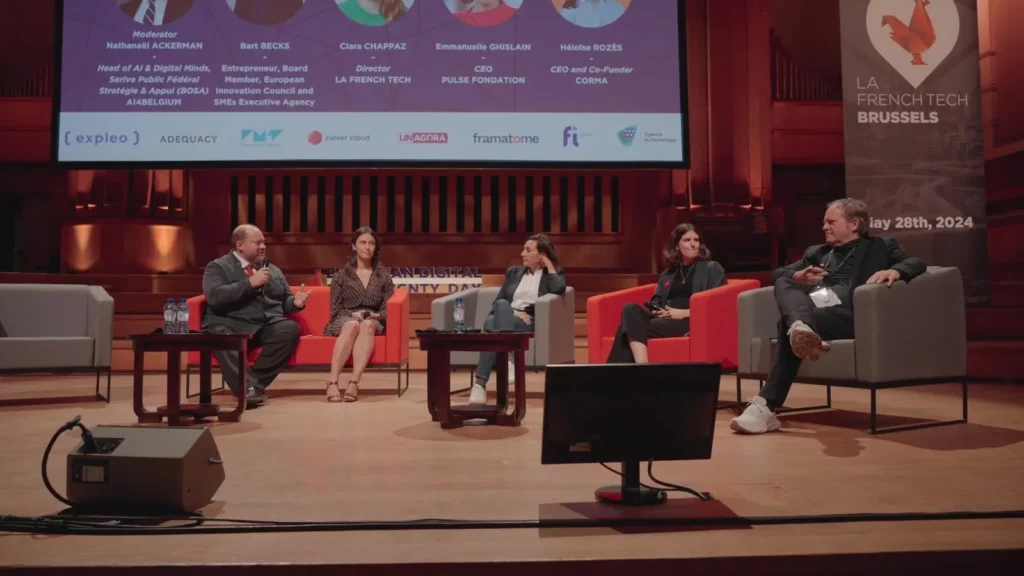
Summit 2024 · Towards European Digital Sovereignty? · 28 May 2024 · Flagey, Brussels
The director of La French Tech, an entrepreneur, a start-up co-founder and the CEO of Pulse debated the growth of start-ups at Flagey in May 2024. Their shared answer: make public and private buyers the customers of these young firms.
Key takeaways
- French Tech owes its success mainly, according to Clara Chappaz, to an Economy ministry administration wholly focused on start-ups
- Bart Becks makes the case for quicker, larger funding rounds
- Presented by Emmanuelle Ghislain, a Pulse report sets out three directions: innovation procurement, regulatory sandboxes and education
A contract rather than a grant. Bart Becks, a serial entrepreneur, and Clara Chappaz made the same case: to help a start-up, an order is worth more than a subsidy. Clara Chappaz, then Director of La French Tech, put it this way: “What those companies need is definitely not one more grant, but one more contract.” Nathanaël Ackerman, of the Federal Public Service Policy and Support and AI4Belgium, chaired the debate.
An administration close to start-ups
For Clara Chappaz, French Tech grew out of a vision from 2013: to bring together entrepreneurs, investors, non-profits and government around one goal. The key factor of success, she said, was a setup in which an administration within the French Ministry of Economy has one objective: to stay close to start-ups. Since the France 2030 plan, the focus has moved from platforms to critical technologies. A third of total venture capital investment in France the previous year went into deep tech start-ups, she noted.
Bart Becks made it a model: Belgium should simply copy parts of French Tech. He took the example of a recent meetup in Tallinn. Estonia, by his account, has 1.3 million people and 10 unicorns. His diagnosis: Europe matches the United States and Asia in research, but has difficulty turning patents into companies. Clara Chappaz, on her side, called for the exchange of knowledge between countries.
Government as first customer?
Another idea from Bart Becks: policy can compensate for the funds that Europe does not have, and government should act as the first customer.
“Why shouldn’t we oblige government or government institutes to work with startups and, instead of giving a grant, sign a two- or three-year contract? That would help a lot more.”
Bart Becks
He also called for faster and bigger funding rounds. In Belgium and in a lot of European countries, he explained, a founder nearly has to take half a year off to raise each new round.
On the French side, Clara Chappaz brought up Je choisis la French Tech, an initiative that encourages corporates and administrations to buy the solutions of start-ups.
A founder facing software chaos
Héloïse Rozès co-founded Corma, a start-up with a Franco-German founding team, based at Station F. Corma tackles what she termed software chaos in mid-sized companies. She gave two figures. These companies now manage over 230 software tools. European solutions are used more and more, but a large majority of the tools, over 65 per cent, are based in the United States. Her conclusion: “So if you put VC money, European VC money, in your company, you can be quite sure that a lot of it will go to U.S. software.”
Daring to start a company
According to Emmanuelle Ghislain, CEO of the Pulse Foundation, Pulse was created 12 years earlier, after a McKinsey study. That study ranked Belgium last in Europe for its culture of entrepreneurship. She also drew on a study that Pulse had just published: 42 per cent of Belgians will not create a company because they are afraid to fail.
Three directions come from a recent Pulse report. The first is public procurement for innovation, with the Dutch Startup in Residence model as an example. The second is regulatory sandboxes. The third is education. In her account, Belgium lacks students in science and technology, faces brain drain and has difficulty recognising diplomas from countries such as Italy or Spain.
To the audience, Héloïse Rozès left one piece of advice: buy from start-ups, or build one.
The third French Tech Sovereignty Summit Brussels takes place on 28 January 2027 at BNP Paribas Fortis, Brussels.