
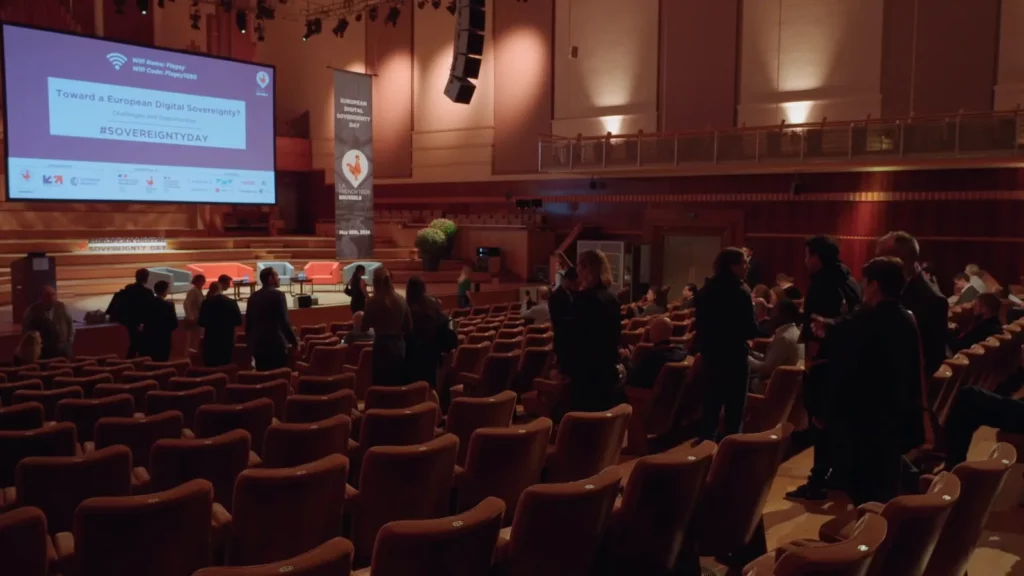
Summit 2024 · Towards European Digital Sovereignty? · 28 May 2024 · Flagey, Brussels
A senior leader of Institut Mines-Télécom and an Agoria expert explored at Flagey in May 2024 how to train more talent for Europe’s digital economy. Their answers: European university alliances, and a closer bond between academia and companies.
Key takeaways
- Correcting the low share of women would help, according to Vincent Charvillat, to train 20 per cent more engineers
- For Jeroen Franssen, Europe must act as one region: collaborate, but also concentrate
- To attract talent, Vincent Charvillat wants the excellence of European training to be better known
Twenty per cent more engineers and managers by 2027. That is the recommendation of the economy minister, who supervises Institut Mines-Télécom (IMT), according to the institute’s deputy director general, Vincent Charvillat. The minister also gives it the means to do so. Alessandra Guion, CEO of Fintech Belgium, moderated the conversation.
More engineers, more women
Vincent Charvillat put forward another figure. In France, the shortfall is estimated at a minimum of 10,000 engineers a year to support this strategy of European sovereignty. For him, one way to achieve the required growth is to correct imbalances, in particular the low share of women.
“The place of women in the thinking about, and the building of, this economy and these technologies is insufficient.”
Vincent Charvillat
Jobs and productivity, a double challenge
Jeroen Franssen, expert on talent and the labour market at Agoria, painted a Belgian picture that starts with good news. Over the previous five to six years, Belgium created an all-time high number of new jobs. It expects solid economic growth, partly based on digitisation. But the picture holds a double challenge. The number of job seekers has fallen sharply, and demographics will not help in the next decade. The second problem is productivity: “Belgium has historically high productivity, but it is no longer rising,” he summed up.
From alliances to European doctorates
On training, Vincent Charvillat pointed to the European university alliances, networks that are still young. He counted about fifty, and soon 60. They combine complementarity and diversity, and they must ensure that organisations are compatible. These alliances could become new institutions that award new degrees. His suggestion: “Why not European doctorates in due form.”
Jeroen Franssen agreed, with two remarks: Europe must collaborate, but it must also concentrate. It cannot have top professors in every emerging technology in every member state. His call: Europe should act as one region. Centres of knowledge would work with decentralised hubs that focus on applying research, not only on fundamental research.
That leaves attracting and retaining talent. For Vincent Charvillat, the excellence of European, Belgian and French training must be correctly marketed, because it is a question of visibility. One speaker added that retention is about attractiveness and upward mobility in the European labour market, not about locking people in.
From campus to companies
For Vincent Charvillat, working with companies is absolutely essential for the academic world. It is a cause he champions within the institute. By listening to companies, researchers and teachers can understand their problems and answer them through research, training and innovation. That takes resources: for Alessandra Guion, this collaboration, like mobility, needs adequate funding.
Jeroen Franssen told a story from Agoria. Every year, Agoria organises a company tour for final-year students in engineering and applied information technology. In a survey at the end of the tour, students reported on average 1.8 companies seen during their higher studies. That figure included the tour itself. In other words, 0.8 companies, not even one.
The third French Tech Sovereignty Summit Brussels takes place on 28 January 2027 at BNP Paribas Fortis, Brussels.