
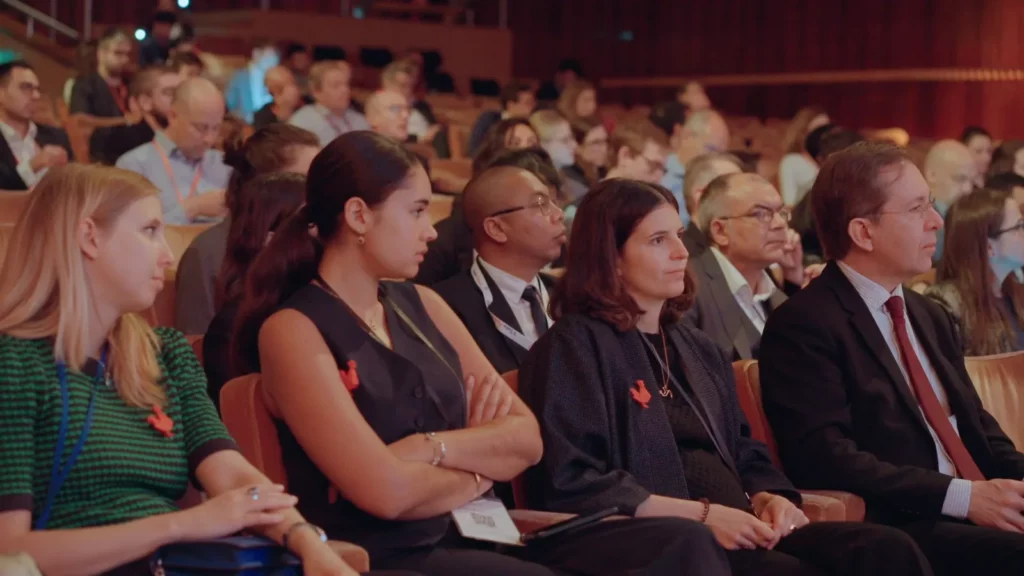
Summit 2024 · Towards European Digital Sovereignty? · 28 May 2024 · Flagey, Brussels
A lawyer and the product owner of a compliance platform toured Europe’s digital laws at Flagey in May 2024, from cybersecurity to artificial intelligence. Their finding: data protection law structures most of these texts, and its logic also applies to AI.
Key takeaways
- For Jérôme Deroulez, European texts on sovereignty generally revolve around four ideas
- According to Alessandro Fiorentino, high-risk AI systems add obligations, not a different method
- As one speaker saw it, the AI Act makes a clear map of data and applications even more necessary
When the General Data Protection Regulation (GDPR) arrived, data protection officers sometimes had to beg security officers for help. The memory is that of Alessandro Fiorentino, product owner of Adequacy, a GDPR compliance platform. In his view, the European NIS 2 directive on cybersecurity could reverse the roles. Security officers may then need their data protection officer to meet the new documentation obligations.
Four ideas behind sovereignty
Jérôme Deroulez, a lawyer at the Paris and Brussels bars, offered a reading grid: “When we talk about sovereignty, in general, when we look at European documentation, we revolve around four main ideas.”
The first idea is security, including cyber risk and industrial issues such as defence. The second is normative power, which reaffirms the values of the European Union and its Charter of Fundamental Rights. The third is innovation. The fourth is openness: for the lawyer, European rules should have a real pulling effect beyond the Union, as the GDPR did on becoming a global marker for data protection.
The GDPR as a template
The legislative agenda he described was very busy. He cited the Digital Services Act and the Digital Markets Act, as well as the regulation on the European Health Data Space. The cyber package includes the NIS 2 directive, the DORA regulation for the financial sector and the Cyber Resilience Act. The AI Act completes the list. Beyond the texts, he pointed to a “grey zone”: the growing role of regulators, national transpositions, guidelines from the authorities and annexes. On top of that come roles such as producer or distributor, which each text defines differently.
Jérôme Deroulez drew several lessons from this. Cyber risk has become an urgent matter at European level. Obligations increase for everyone, and the principle of accountability, already present in the GDPR, is reinforced. Companies must determine their own role and identify the responsibilities of each party in the chain, including subcontractors and distributors. Regulators gain power, and new sanction systems appear. The scope of the texts covers everyone operating on the European market, not only Europeans.
As he saw it, data protection law structures most of these instruments. In the AI Act, the gradation of systems by risk, from prohibited systems to high-risk systems, and the impact assessments are inspired by the GDPR.
Six checks before AI
Alessandro Fiorentino singled out two texts, NIS 2 and the AI Act. For him, “the NIS 2 directive […] will bring security into the world of law”. Behind any AI there will be data, very likely personal data. So the same logic applies.
He proposed six checks. The first three cover the applicable legal framework, the purpose and the legal basis. Next come the compatibility of any further processing with the initial purpose, the risk analysis and privacy by design. Alessandro Fiorentino’s advice: “Whatever AI project you deploy, you will really have to check these six points before industrialising.” High-risk systems will carry more obligations, but the method stays the same.
A marker beyond Europe?
One of the speakers observed that mapping data and applications becomes even more important with the AI Act. AI could generate new flows between applications. Organisations without a clear map of their applications would then find compliance harder.
Jérôme Deroulez envisaged the AI Act becoming a marker not only in Europe but internationally, for example through the way it classifies AI systems. He left one question open: will Europe succeed in building a true body of rules and a real digital sovereignty?
The third French Tech Sovereignty Summit Brussels takes place on 28 January 2027 at BNP Paribas Fortis, Brussels.