
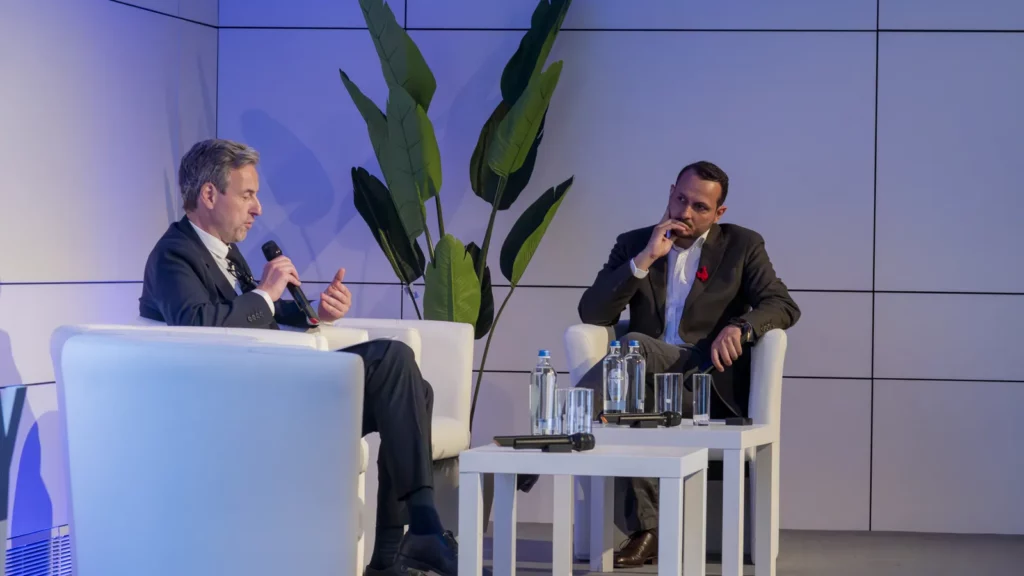
Summit 2025 · Time for Action · 23 June 2025 · Square Brussels
In Brussels in June 2025, a member of the cabinet of the European Commission’s Executive Vice-President argued that regulation is not enough. He set out the Commission’s answer: invest in computing and artificial intelligence, and diversify Europe’s partners.
Key takeaways
- According to Xavier Coget, the Commission wants start-ups to access the AI factories already open to researchers
- He cited the EU’s digital partnerships with Japan, Korea, Singapore and India
- His cabinet is pushing, he said, for more resources for digital in the next EU budget
For Xavier Coget, Europe is probably ahead globally in regulating tech. Regulation, if done smartly, can help to create one single digital market, instead of 27 different sets of rules. But this is not enough.
At the time a member of the cabinet of Executive Vice-President Henna Virkkunen, he was questioned by Samuel Profumo, president of La French Tech Brussels, on the Commission’s economic tools.
Competitiveness through computing
Xavier Coget cited the Draghi report, which puts Europe behind the United States and China in tech innovation. For this Commission, investing in the tech competitiveness of Europe is a top priority.
Computing power comes first on his list. The Commission is increasing supercomputing capacity through AI factories in several member states. Researchers already have access to them, and the Commission now wants start-ups to have access too. It is also creating AI gigafactories, which he described as four times bigger.
According to him, Europe has more AI researchers than the United States. But its AI start-ups often go to the United States to get capital and to scale up. Next steps announced: an applied AI strategy for later in the year, then a Cloud and AI Development Act, probably for early the following year.

Diversifying partners
Xavier Coget presented the EU international digital strategy, adopted on 5 June. In his view, Europe is too dependent on technology from outside. He backed this up with a figure his Executive Vice-President often gives: 80% of Europe’s tech is imported. He gave the example of the United States: even they cannot produce everything. Europe must invest in its competitiveness, but it will still import technology. He therefore made the case for diversification, so that Europe does not depend on one or two suppliers.
The EU, he added, was then negotiating a trade agreement with the United States. Its wish: “We want to have a good partnership with the U.S., but to also be free to […] choose what we want.” It wants good competition across the board and more European solutions, including in cloud. The EU also has ministerial-level digital partnerships with Japan and Korea, as well as with Singapore and India, to cooperate on research, skills and AI.
More resources for digital
According to Xavier Coget, a proposal for the next EU budget was due soon. His cabinet is pushing to dedicate more resources to digital and tech innovation, in the hope that this could be a game changer.
Xavier Coget addressed entrepreneurs who still doubt Europe’s capacity to act. He pointed them to the number of initiatives linked to tech sovereignty and tech competitiveness: “It’s probably the area where we have launched the largest number of initiatives, and the most ambitious.”
The third French Tech Sovereignty Summit Brussels takes place on 28 January 2027 at BNP Paribas Fortis, Brussels.