
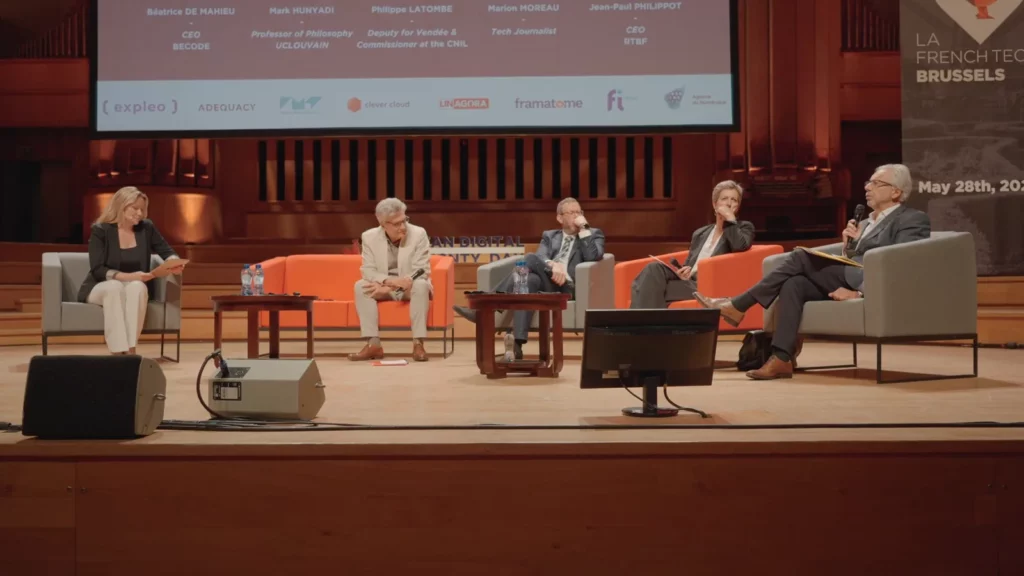
Summit 2024 · Towards European Digital Sovereignty? · 28 May 2024 · Flagey, Brussels
At Flagey in May 2024, the moderator asked a lawmaker, a philosopher, the CEO of a coding school and the head of RTBF: is the digital space still democratic? Their answers pointed to what is still to be built: values, training and cooperation.
Key takeaways
- Mark Hunyadi proposed that the human mind be declared a common heritage of humanity, like the seabed
- According to its CEO, BeCode put generative artificial intelligence on the curriculum as soon as it arrived, stressing critical thinking
- Jean-Paul Philippot called on public media to join forces, with each other and with technology partners
Information highways with no highway code and no driving schools: the image came from Jean-Paul Philippot, Administrator General of RTBF. In 1994, Jacques Delors launched those highways on an idea of freedom of access, of expression and of contact. The highway code was then forgotten, in his words, and no driving schools were created.
The head of RTBF drew a conclusion from it: “I think that today, we cannot claim that the digital space is a democratic space.” The year 2024 saw many elections around the world. Belgium was to vote ten days later in the European elections. Voting there was open from the age of 16. His forecast: most of these new voters would get their information on social networks, with no guarantee on the quality of content or the neutrality of algorithms.
Taking over the mind’s work
Mark Hunyadi, professor of philosophy at UCLouvain, approached digital technology in a specific way: “It is truly a technology of the mind.” Digital tools now take over functions of the human mind, such as producing meaningful texts. Their anti-democratic force, in his analysis, is to address users as beings who seek immediate satisfaction, and to bypass judgement. Fake news? Sugar for the brain, because it activates the circuits of pleasure.
From rights to values
In the philosopher’s eyes, individual rights, protected through the General Data Protection Regulation (GDPR) or other tools, are not equal to this challenge. His proposal: declare the human mind a common heritage of humanity, as was done for the seabed in 1982.
Philippe Latombe, a French MP for Vendée, agreed with him on one point: consent is not everything. In his view, lawmakers should set values rather than technical rules. His example dates from 2018. A cross-party working group of deputies and senators had then considered a digital rights charter in the preamble of the French Constitution. The reform was abandoned.
Learning to drive
That leaves the drivers to train. Béatrice de Mahieu is CEO of BeCode, a coding school in Belgium. The school, she explained, trains people who are vulnerable on the job market for jobs in tech. BeCode brought generative artificial intelligence into its curriculum as soon as it appeared, with a focus on critical and logical thinking.
Optimistic, Béatrice de Mahieu saw tools such as ChatGPT as a good assistant for the coders BeCode trains, not a replacement. Are her learners aware of sovereignty issues? Her answer: not enough.
Building as Europeans
RTBF, Jean-Paul Philippot said, does not give the large search engines access to its data. He also offered a comparison. By his reckoning, European public media invest as much in original content as Netflix each year, while Netflix spends ten times more on its platform’s technology. His conclusion: public media must work together and with technology partners.
Philippe Latombe placed his trust in the future, provided Europe builds it, as it did with the GDPR. He doubted, however, that a global agreement could be reached.
An optimist like Béatrice de Mahieu, Jean-Paul Philippot wanted a European framework and anticipatory regulation. This time he drew his image from the car industry: “Nobody would buy a car that has not passed a crash test.”
The third French Tech Sovereignty Summit Brussels takes place on 28 January 2027 at BNP Paribas Fortis, Brussels.