
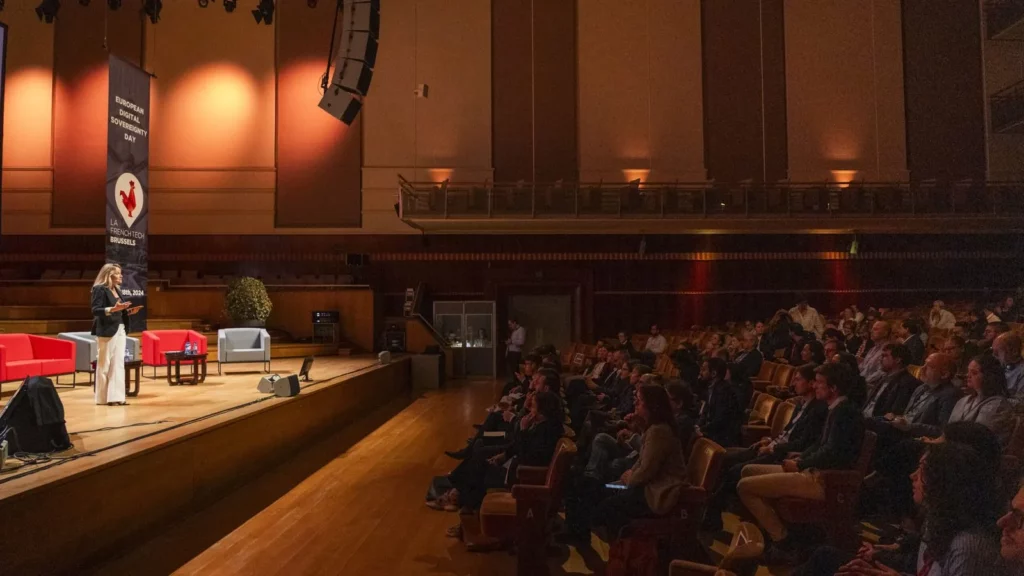
Summit 2024 · Towards European Digital Sovereignty? · 28 May 2024 · Flagey, Brussels
A French diplomat, a European Commission official and an economist opened the first French Tech Sovereignty Summit Brussels at Flagey in May 2024. Their speeches ranged from French digital policy to European rules on platforms, and on to artificial intelligence.
Key takeaways
- For Caroline Vinot, French digital policy stands on three pillars: data protection, regulation and funding for innovation
- Thibaut Kleiner sees Europe placing its values at the source of its rules and of its technologies
- Bruno Colmant believes artificial intelligence above all raises the question of how productivity gains are shared
“It simply means that we take our destiny into our own hands.” With this simple sentence, Thibaut Kleiner began to define sovereignty on behalf of the European Commission, where he was a director. In his telling, the notion was still fairly new at European level. It was met at the start with scepticism, and with a question: protectionism or not? The idea gained real acceptance over the past five years.
Three pillars, the French way
For Caroline Vinot, chargée d’affaires ad interim at the Embassy of France, French public policy on the digital space rests on three pillars. The first is a framework for data protection. The second is a regulatory framework, with the Digital Services Act and the Digital Markets Act as examples. The third is a real policy to finance and support innovation. Each pillar applies at national and at European level.
She gave two figures. The France Relance and France 2030 plans devoted a little over one billion euros to breakthrough innovation, deep tech and artificial intelligence. In a decade, by her account, the number of French start-ups grew from 1,000 to 25,000. France was also due to host a summit on artificial intelligence in February 2025.
From values to rules
Thibaut Kleiner’s definition also includes technology that serves individuals, and that is not used against people, democracy or human rights. He saw in this a specific feature of Europe: policies that place its values and principles at the origin of its regulation, and also of the technology it produces.
He showed this regulation at work on platforms. App stores must now let entrepreneurs deal directly with their customers without paying 30 per cent. After Commission action, TikTok withdrew a Lite version that, in his account, encouraged children to spend the whole day in front of the screen. The Commission was also acting, he stated, so that products offered by Alibaba in Europe are not counterfeit and meet European safety standards.
“This regulation is being implemented now. We are at the very beginning, but it works.”
Thibaut Kleiner
He also put figures on the European effort. The European Innovation Council had invested one billion euros in start-ups since 2022. His services at the Commission invest more than two billion euros in innovation every year.
A Copernican revolution
For Bruno Colmant, an economist, artificial intelligence (AI) is a Copernican revolution. After the Neolithic and the industrial revolution, he argued, a third shift is under way. In it, human cognitive capacities will be extended on a scale that is hard to imagine today.
The real question, for the economist, is the sharing of productivity gains. Tax and social systems still rest on a manufacturing model, in which labour finances the State. According to him, capital, which supplies the tools that replace human work, will win over labour.
An industrial policy for AI
Europe, according to Bruno Colmant, largely missed the liberalisations meant to drive innovation, in energy and in telecommunications. His verdict: “Europe today finds itself in the worst situation, that is, being the consumer of what is invented and produced abroad.”
Without a surge of European sovereigntism, he warned, Europe would more than likely face the same situation with artificial intelligence. Productivity gains would then flow out of European economies. He drew from this a call to European industrial policy: to focus on this change. His conclusion: unlike in other fields, it is not too late.
The third French Tech Sovereignty Summit Brussels takes place on 28 January 2027 at BNP Paribas Fortis, Brussels.