
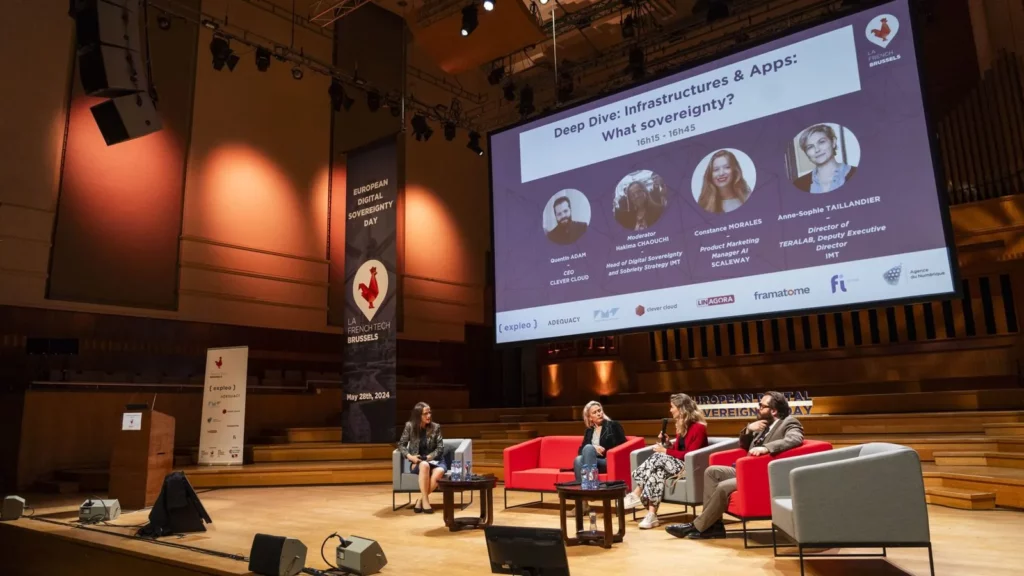
Summit 2024 · Towards European Digital Sovereignty? · 28 May 2024 · Flagey, Brussels
The CEO of Clever Cloud, a Scaleway manager and a senior executive of Institut Mines-Télécom (IMT) debated cloud sovereignty at Flagey in May 2024. Their answers ranged from the very nature of cloud to the choice of a provider, and on to the organisation of supply chains.
Key takeaways
- Quentin Adam likens computing to an industrial revolution, one that now mechanises brains
- Constance Morales advises checking, with contracts to back it up, where data is stored, from training to inference
- Anne-Sophie Taillandier presented the Gaia-X labels, from self-declaration all the way to certification
Unified billing, identity and access management, access logs, a managed application programming interface (API). For Quentin Adam, CEO of Clever Cloud, cloud began when infrastructure started to be consumed together with these services. It is therefore neither an infrastructure nor a technology. He attributes Europe’s delay to a misunderstanding of this point. Hakima Chaouchi, of IMT, moderated the debate.
“Today, cloud is software.”
Quentin Adam
Data on the move
Quentin Adam, asked about applications once they are deployed, also sees risks in that software. Applications are split into ever more abstract services. APIs send calls to unknown places. Databases can span several regions. Data can thus end up under extraterritorial laws. The risk is failing to identify this.
Choosing a provider
Constance Morales, Product Marketing Manager AI at Scaleway, first defines sovereignty as operational autonomy. That autonomy must give tomorrow’s European start-ups the hardware and software they need. Sovereignty also means data confidentiality as defined by the General Data Protection Regulation (GDPR).
She set out three criteria for choosing a provider, and applied them to Scaleway. First, its data centres are in Europe, in France, Poland and the Netherlands. Second, Scaleway belongs to Iliad, which she described as a 100 per cent French holding company. In her words, Scaleway is therefore not under extraterritorial jurisdiction. Third, she places the choice of open source at the heart of how Scaleway works.
Her advice to users: at every stage of AI, from data to training and inference, ask where their data is stored, notably through contracts.
How can users be steered towards sovereign applications? The speakers’ answers: objective criteria, caution about offers that are free at first, and interoperability rather than vendor lock-in. One speaker judged that sovereignty may simply be a choice.
Trust can be measured
Anne-Sophie Taillandier, Deputy Executive Director at IMT, spoke as coordinator of the Gaia-X Hub France. Her starting point: “Data can only circulate if there is trust.” IMT is a founding member of Gaia-X. According to her, this Brussels-based association has 330 members and around twenty hubs.
Gaia-X labels have three levels. They cover data protection, contracts and jurisdiction, cybersecurity, and portability and interoperability. A part called European Control measures immunity from non-European extraterritorial laws. In total, Anne-Sophie Taillandier counts 63 criteria that make trust measurable. They range from self-declaration, at the first level, to certifications, at the third.
Mechanising brains
Quentin Adam sees computing as an industrial revolution of intellectual work. In the nineteenth century, human muscle was mechanised. Today it is brains. He draws a warning from this: a company that places that mechanisation entirely with a provider loses its value. His conclusion: computing is an industrial value chain, and the first rule of industrialisation is to have several supply chains, including local ones.
For him, software also carries a culture, and European culture includes respect for personal data. His formula fits in two sentences: “The GDPR is not a problem. The GDPR is an opportunity.”
The third French Tech Sovereignty Summit Brussels takes place on 28 January 2027 at BNP Paribas Fortis, Brussels.