
Summit 2025 · Time for Action · 23 June 2025 · Square Brussels
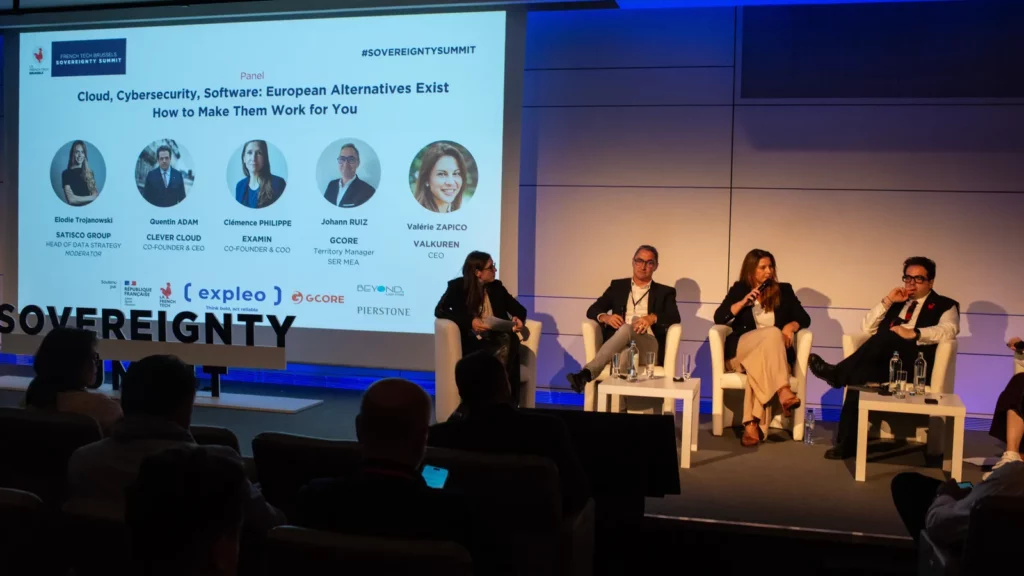
In June 2025 in Brussels, four European players in cloud, compliance and artificial intelligence explained why and how to move to European solutions. Their ideas: migrate step by step, make the European offer better known and build on European law.
Key takeaways
- According to Johann Ruiz, of Gcore, clients move for reasons including data sovereignty and the freedom to change provider
- Valérie Zapico, of Valkuren, proposed a single access point to trusted European companies, promoted by every European country
- Quentin Adam, of Clever Cloud, invited buyers to try European products, then to report back
“The clients of our startups, and our clients, ask for European providers. This is now a competitive advantage.” The words are those of Clémence Philippe, co-founder and Chief Operating Officer of Examin, who works a lot on the General Data Protection Regulation (GDPR). She had an idea for accelerators and incubators in France, Luxembourg and Belgium. They could offer start-ups European providers such as OVH or Scaleway from the start, with discounts.
Why clients move
Élodie Trojanowski, Head of Data Strategy at Satisco, moderated the debate. According to her, large US cloud providers are the first to come when a start-up begins, with large discounts. And switching the everyday tools of a whole organisation is a hard decision.
At Gcore, Johann Ruiz, a Territory Manager, spoke as a cloud provider. He gave three reasons why clients move. They want data sovereignty. They want to avoid the lock-in that grows with their volume of data at a single large provider. And they want to respect the GDPR and related certification requirements.
For Valérie Zapico, founder and CEO of Valkuren, independence and control of strategic data are not reserved for defence or institutions. Industrial and pharmaceutical companies want to protect their information too. The right course: move slowly, and mix new tools with what they have today.
A step-by-step migration
All at once or gradually? Quentin Adam, co-founder and CEO of Clever Cloud, compared IT to any industrial value chain, where nobody relies on a single supplier. His advice to organisations: start somewhere, and migrate part of their business step by step. He also called for a Buy European Act and a Small Business Act. The aim: for the public sector and large corporations to buy part of their equipment from small local companies.
Johann Ruiz’s method: start with 10 or 15 per cent, for example strategic data, then move the rest smoothly. He also described a trust gap: in his view, a European choice must always be justified. Onboarding small and medium-sized enterprises and start-ups onto European solutions will help to build that trust.

Getting known, getting tested
How do start-ups find the European offer? Valérie Zapico argued for a one-stop shop of trusted European companies, promoted by all the countries of Europe. She called on everyone to start together. Other speakers asked for a referenced list of approved European solutions, and for stronger marketing.
To buyers, Quentin Adam made a request: test European products and give feedback, even when they do not choose them.
European law as an asset
Quentin Adam called on Europe to stand for its values, including democracy, and to enforce its law. The GDPR, he explained, helps his company do business outside Europe. His conviction: “GDPR is our cultural choice to think that privacy and human rights are more important than business.”
The third French Tech Sovereignty Summit Brussels takes place on 28 January 2027 at BNP Paribas Fortis, Brussels.